

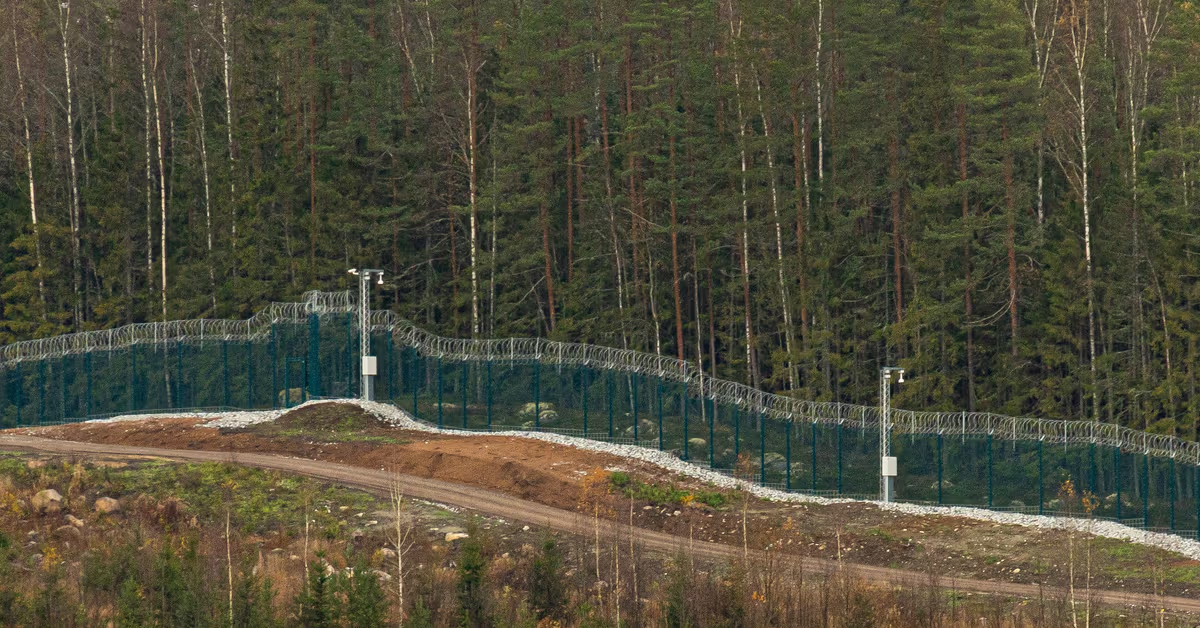
Finland Completes Major Border Fence Project Along Russian Frontier
In a significant development for European security, work on the fencing along Finland’s expansive 1,340-kilometer border with Russia has officially concluded after three years of construction. The ambitious project was completed on Monday, marking a pivotal moment in Finland’s approach to safeguarding its eastern frontier.
At a press conference held near the Nuijamaa border crossing in southeastern Finland, Interior Minister Mari Rantanen of the Finns Party addressed the media, emphasizing the possibility of extending the fencing in the future. “It’s wise for us to assess whether additional measures are necessary,” Rantanen stated, adding that securing EU funding would be crucial for the ongoing enhancement of border security in eastern member states.
Finland’s border with Russia not only represents the longest boundary shared by any European Union or NATO member with its eastern neighbor but also comes in the wake of heightened security concerns following Russia’s invasion of Ukraine in 2022. Rantanen underscored that the geopolitical landscape has shifted dramatically, necessitating the construction of the fence as a critical response to evolving threats. “In this situation, every state must take responsibility for its security and protect its borders,” she affirmed.
The government has set the financial outlay for the border fence at an estimated 380 million euros, with construction having been completed slightly ahead of schedule. This initiative also includes a proposed two-year extension of the Border Security Act, aimed at bolstering Finland’s defensive posture against potential hybrid threats, such as “instrumentalized migration,” which involves leveraging large groups of asylum seekers as a form of political coercion.
Finland made the decision to close its border with Russia late in 2023 amid concerns about the eastern neighbor’s possible use of such tactics. The current fencing spans approximately 200 kilometers, with the longest stretches concentrated in the southeast, comprising around 140 kilometers. Additional segments of the fence extend through North Karelia and into Finnish Lapland, reflecting a comprehensive strategy to secure vulnerable points along the border.
The project’s inception can be traced back to a political consensus reached in October 2022 among Finland’s party leaders, who recognized the urgent need for enhanced border defenses. Initial construction began with a pilot project in Pelkola, near Imatra, in April 2023, laying the groundwork for the extensive fencing that now stands.
As Finland navigates these challenging waters, the completion of the border fence serves not only as a symbol of national security but also as a testament to the collective will to protect the integrity of its borders amidst a rapidly changing geopolitical landscape.
