

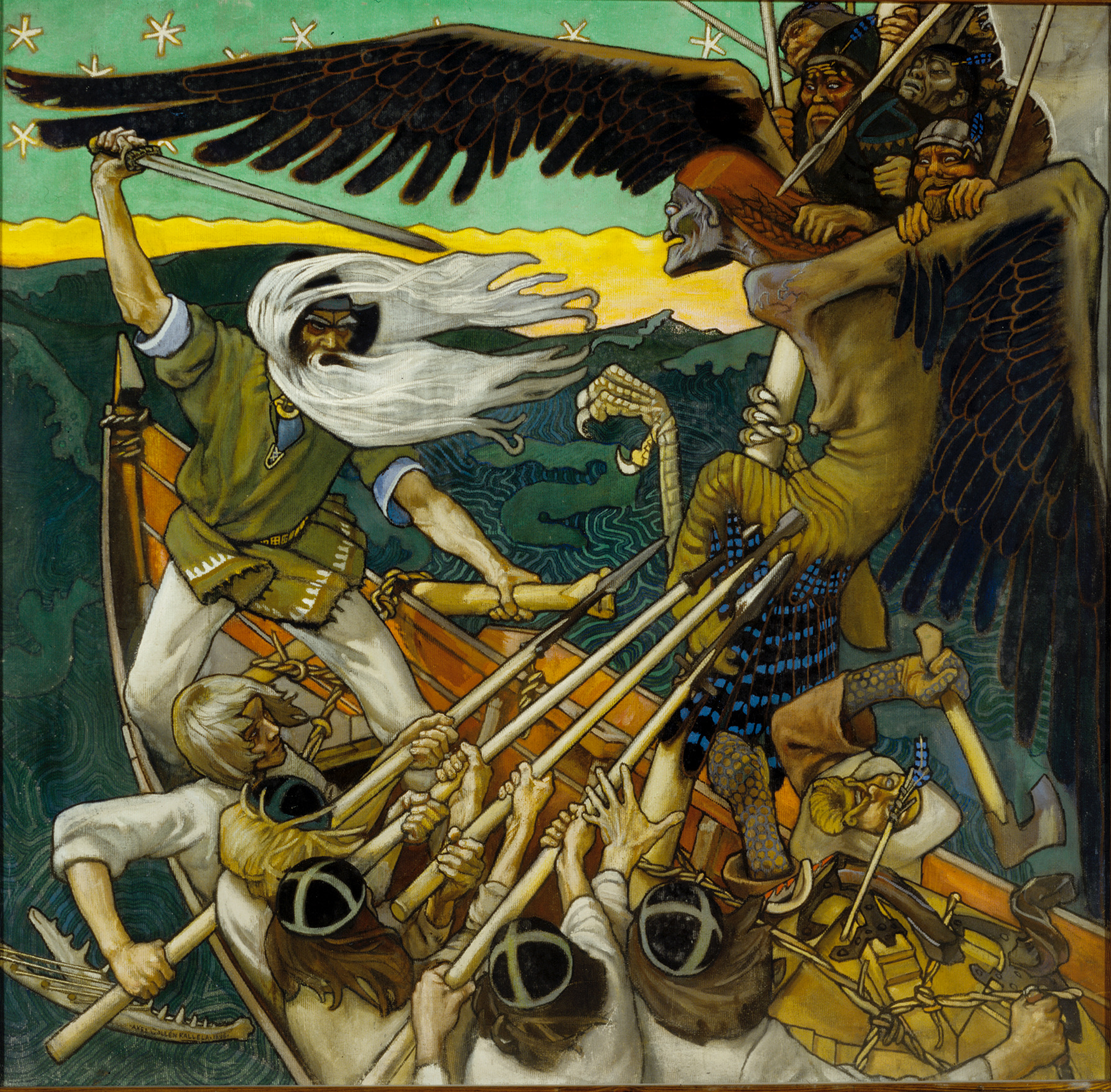
Much like Norse mythology, Finnish mythology is a tapestry woven with gods, heroes, and an array of enchanting creatures. Yet, the tales from the land of a thousand lakes remain less familiar to most beyond the Nordic borders.
At the core of this rich tradition is *The Kalevala*, Finland’s national epic—a collection of ancient poems and legends that has inspired figures as diverse as J.R.R. Tolkien and contemporary artists and composers.
So, who are the key players in Finnish mythology? Here’s your essential guide to the heroes, gods, and mystical beings that populate these captivating stories.
Origins of Finnish Mythology and *The Kalevala*
For centuries, Finns have been sharing stories of their guardians, long before the nation embraced Christianity. Once passed down orally, these tales found permanence in written form. The most renowned of these works is, of course, *The Kalevala*. Compiled by Elias Lönnrot, a physician and folklorist, this collection was published for the first time in 1835, with a revised edition following in 1849. Lönnrot drew from centuries of traditional runic songs to capture the essence of Finnish culture.
*The Kalevala* is widely regarded as Finland’s national epic and is a cornerstone of Finnish literature, expressed through a rich tapestry of poems, ballads, and songs. However, it’s worth noting that this was not the first written depiction of Finnish mythology. In the 16th century, Mikael Agricola endeavored to document key aspects of Finnish myths, earning him the title of ‘father of literary Finnish’. Nevertheless, *The Kalevala* remains a standout work, continuing to spark inspiration in contemporary writers.
The Main Characters of *The Kalevala*
To fully appreciate *The Kalevala*, it’s essential to familiarize yourself with its various figures. Here are a few pivotal characters worth knowing!
Väinämöinen
Often hailed as the epic’s central hero, Väinämöinen embodies the archetype of the wise old sage—a masterful singer and a wielder of magic. He is best likened to a blend of bard, shaman, and wizard. If you are a fan of *The Lord of the Rings*, you may recognize shades of this character in Tolkien’s ‘Gandalf’.
Gifted with extraordinary wisdom and musical talent, Väinämöinen’s singing is said to have a magical quality. He is frequently depicted with a kantele, a traditional Finnish harp, whose entrancing melodies draw not just human listeners but also animals and celestial beings.
Ilmarinen
Another significant figure in *The Kalevala* is Ilmarinen, the legendary eternal blacksmith. Renowned for crafting magical artifacts, he is particularly famous for the elusive Sampo—a fabled object said to generate endless wealth from thin air. While the text does not definitively describe what Sampo is, interpretations suggest it produces essential resources like grain, salt, and gold. Many deities covet this powerful item, which highlights its pivotal role across the epic. Ilmarinen is also credited with forging the dome of the sky, among his other remarkable creations.
Joukahainen
In essence, Joukahainen stands as Väinämöinen’s rival—not a villain, but a young man brimming with confidence, convinced of his own superiority. Finnish mythology often eschews black-and-white morality, focusing instead on the chaos versus heroism dynamic. Joukahainen’s challenge to Väinämöinen to a singing duel results in his defeat and a banishment to a swamp.
Lemminkäinen
Lemminkäinen is characterized as an attractive youth and a valiant warrior, deeply attached to his mother. One poignant myth recounts his tragic drowning in the river of Tuonela—the boundary between the living and the dead. However, his devoted mother eventually brings him back to life.
Key Gods and Goddesses in Finnish Mythology
Ukko: The god of weather and thunder, often likened to Thor in Norse tradition.
Tapio and Mielikki: The divine couple presiding over the forest.
Louhi: The formidable sorceress ruling Pohjola, a land steeped in mystery.
Ahti and Vellamo: The revered deities of water.
Tuoni: The god of the Tuonela, the underworld.
Päivätär and Kuutar: Goddesses representing the sun and moon, sisters in their celestial duties.
Creatures in Finnish Mythology
The Kalevala also introduces us to a variety of fascinating creatures. Here’s a glance at some:
- Otso: The bear, revered as the king of the forest and a divine spirit.
- Menninkäinen: Tiny nature spirits dwelling beneath the earth.
- Näkki: A perilous water spirit known for luring humans into lakes and rivers.
- Holdon: An elf-like figure who enjoys assisting people.
- Will-o-wisps: Small luminous spirits hovering over water bodies, visible at night.
- Iku-Turso: A fearsome sea creature resembling an octopus, sometimes sprouting wings.
- Hiisi: Once considered a sacred spirit, it evolved into a menacing forest being.
- Keiju: Charming, fairy-like beings known for their beauty and small stature.
The Myths of *The Kalevala*
Having explored the characters and spirits, we can now delve into the enchanting legends that *The Kalevala* weaves.
The Creation of the World
In a primordial time, Ilmitar, a virgin spirit and goddess of air, slumbered upon tranquil waters for eons. When she finally awoke, a bird landed on her lap, laying seven eggs—six crafted from gold, and one from iron. The eggs tumbled into the water and shattered, giving birth to the Earth: the shell’s base formed the land, the top became the sky, the egg white transformed into the moon and stars, while the yolk eventually became the sun. From Ilmitar’s essence emerged Väinämöinen, who spent years traversing the seas before stepping onto land.
The Sampo
Many stories in *The Kalevala* orbit around Sampo, a coveted object that nearly everyone yearns to possess. Recall the singing duel between Väinämöinen and Joukahainen? After his defeat, Joukahainen shoots Väinämöinen, sending him into a watery grave. He washes ashore in the foreboding North, ruled by Louhi, who nurses him back to health—but not without demanding a hefty price: Sampo. With Ilmarinen as its creator, Louhi proposes a deal he can’t refuse: one of her daughters in exchange for Sampo.
Thus, Sampo changes hands, securing Ilmarinen a bride and freeing Väinämöinen from his debt. Later, a quest involving Väinämöinen, Ilmarinen, and Lemminkäinen to reclaim Sampo unfolds, but not without consequence: when triumphant, the object shatters into pieces.
More Myths from Finland
The Three Souls
In Finnish belief, the soul is divided into three parts: the henki, luonto, and itse. The henki, a gift from birth, represents life itself, responsible for our very breath. The luonto is the ‘main’ soul, entering the body shortly after birth and persisting beyond death. Lastly, the itse embodies one’s inner self or personal identity.
The Northern Lights
Finland ranks among the prime locations for witnessing the northern lights, spawning a host of legends about their origins. One popular tale features a mystical fox, with the Finnish term for aurora—*revontulet*—literally translating to ‘fox fires’. According to lore, the shimmering lights result from a magical fox darting through the snow, its tail igniting sparks that illuminate the sky. In contrast, *The Kalevala* presents a darker interpretation, describing the auroras as ‘the flaming gates of the north.’
The Sámi people of Sápmi, comprising northern parts of Finland, Sweden, and Norway, have their own deep-rooted beliefs regarding the northern lights, often view them as ancestral spirits to be respected. Across Finland, traditions link these magnificent displays to powerful magic and sorcery.
Is Finnish Mythology the Same as Norse Mythology?
Despite Finland’s geographic proximity to Sweden and Norway, Finnish mythology has developed independently and bears distinct characteristics. Rather than centering on deities like Odin, Thor, and Loki, Finnish tales focus more on figures such as Väinämöinen, Ilmarinen, and Louhi. The narratives place a stronger emphasis on the themes of nature, forests, and magical song than on the exploits of warrior gods.
Is *The Kalevala* Worth Reading Today?
Although initially crafted as poetry, modern English translations make *The Kalevala* far more accessible. Even if you’re unable to read the entire epic, exploring a few select stories will enrich your understanding of Finnish culture.
What Makes Finnish Mythology Unique?
Finnish mythology is replete with creative and original narratives—singing battles, the enigmatic Sampo, and the whimsical fox fire are just a few examples. Additionally, the profound reverence for nature evident in these tales continues to resonate with many Finns today, deepening their appreciation for Finland’s exquisite landscapes.
The echoes of Finnish mythology can be spotted in modern culture, as seen in J.R.R. Tolkien’s works, which draw inspiration from *The Kalevala*. Elements of the Finnish language reportedly influenced Tolkien’s construction of Quenya, one of his Elvish languages.
Although many ancient beliefs waned with Christianity’s arrival, the imprint of Finnish mythology endures, shaping the nation’s identity through literature, music, festivals, and contemporary fantasy. Today, the influence of *The Kalevala* remains deeply woven into the fabric of Finnish life.
Have you explored *The Kalevala*? Or do you have a favorite character or creature from Finnish mythology? We invite you to share your thoughts in the comments below.
See also:
Norse vs. Scandinavian: What is the Difference?
Norse Paganism Explained
Norse Gods and Goddesses
